Flavor consistency is an important element in food production. Whether it’s a packaged product, a restaurant dish, or a large scale recipe, the expectation stays the same i.e. every batch should taste identical.
But achieving that consistency is difficult. It’s because fresh ingredients vary; storage conditions change, and preparation methods differ. That’s where garlic, in its different forms, has a quiet but essential role.
Why Consistency Matters More Than Ever?
In the current food industry, customers expect reliability. They prefer the same taste every time. They want the same aroma and the same overall experience. Customers can even notice a slight variation. Garlic is a strong and defining ingredient, which often maintains that balance.
The Challenge with Fresh Garlic
Fresh garlic adds depth and intensity, but it comes with unpredictability. Clove size varies, and its moisture content changes. Flavor strength can vary from batch to batch.
For small scale cooking, this may not matter much. But in commercial production, minor inconsistencies can affect the final product.
The Advantage of Processed Forms
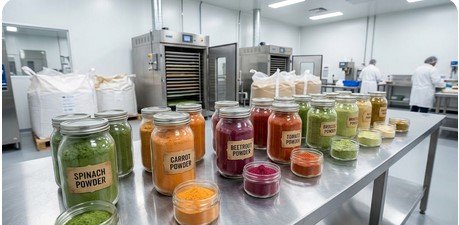
Using controlled and processed forms ensures stability. This is where dehydrated vegetable powders and other forms of garlic can be a good choice. They offer uniformity in flavor strength, texture, and shelf life.
Every batch is processed under standard conditions, which makes it easier to maintain consistent taste profiles.
What are the different garlic forms?
Garlic is available in different dehydrated forms, each for specific applications.
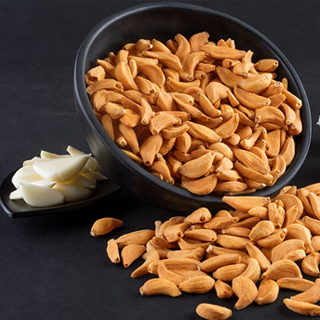
Flakes or Kibbled Garlic (8–15 mm)
They are ideal for recipes that require visible texture and slow flavor release, and maintain structure while delivering a strong aroma typical of Indian origin products.
Chopped Garlic (3–5 mm)
This form blends more easily into sauces, soups, and ready to cook mixes while offering a balanced flavor distribution.
Garlic Powder (80–100 mesh)
It’s fine and uniform, perfect for seasoning blends, snacks, and processed foods where smooth texture and even mixing are essential.
All these variants are typically produced in controlled environments, while ensuring A grade quality, strong aroma, and consistent color. Packaging in durable poly lined cartons (commonly 14 KG or 20 KG) can preserve freshness during storage and transport.
Supporting Large Scale Production
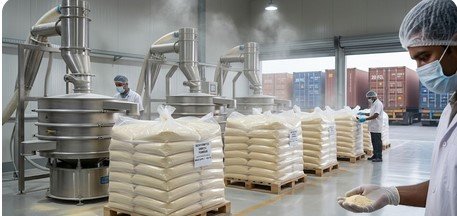
For manufacturers, consistency is critical. Working with a reliable dehydrated vegetable manufacturer in India ensures that raw materials meet strict quality standards. From sourcing in regions like Hyderabad to maintaining hygienic processing conditions, every step significantly contributes to uniformity.
Bulk supply options, including 20 FCL and 40 FCL quantities, make it a lot easier for businesses to scale production without compromising on quality.
The Role of Standardization
Dehydrated ingredients are effective for not just for convenience; instead, it’s standardization. Every product is processed to maintain uniform particle size, strong and stable aroma and consistent color and texture. This level of control ensures that recipes taste the same, even when produced at scale.
A Reliable Approach to Flavor
In the end, the flavor consistency comes from control. It’s about the control over ingredients, processing, and quality. Using garlic in its dehydrated form helps manufacturers and chefs to achieve that control without sacrificing flavor. Because when every detail is managed carefully, the final product delivers the same taste every single time.
At Unigen Exports, we deliver premium quality Indian agri products and spices with honesty, consistency, and care. Our company is focused on building long term partnerships through reliable supply, fair pricing, and timely delivery. That’s why we are the trusted and dependable choice for sourcing high quality products directly from India.